Most people plan the procedure carefully and the recovery not at all. That is backwards: the surgery takes one day, the recovery takes a year, and almost every patient who panics does so at a completely normal stage. Here is the honest timeline, including the part nobody enjoys.
Days 0–3: the swelling window
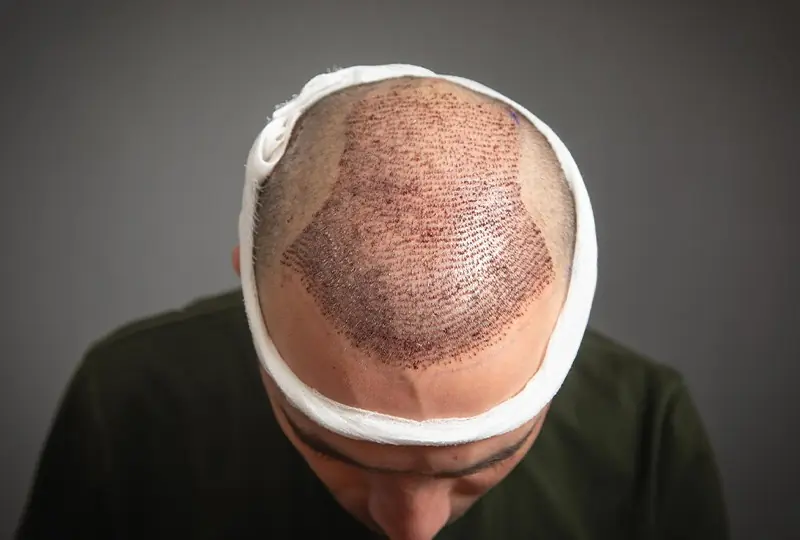
You leave the clinic with the recipient area dotted with tiny scabs and the donor zone shaved and reddened. Swelling usually appears on day two, peaks on day three, and often travels down to the forehead and around the eyes before it settles. It looks alarming and is entirely mechanical — fluid from the anaesthetic following gravity.
Sleep at 45 degrees for the first three nights. Do not let a pillow, a hoodie or a car headrest touch the grafts. Most desk-based patients are back at work on day four.
Days 4–14: the first wash and the scabs
The first wash is done at the clinic so you can see exactly how much pressure is safe — considerably more than people expect. From then you wash daily with the lotion and shampoo in the aftercare kit. Scabs soften and clear between days ten and fourteen; picking them off early can take the graft with them, which is the one avoidable way to lose density.
By day fourteen the recipient area usually looks like a short, even buzz cut. This is the point at which patients feel best about the whole thing.
Weeks 3–8: shock loss
Then the transplanted hairs fall out. All of them, more or less, over two to four weeks. This is shock loss, it is expected, and it is not a failure: the follicle stays in place and enters a resting phase while the shaft is shed. Some native hair around the recipient sites sheds too and regrows on the same schedule.
Month two is the psychological low point of the process. You have paid, you have healed, and you look exactly as you did before — sometimes slightly thinner. Every patient goes through it.
Months 3–6: the first real growth
New shafts start pushing through around month three to four. They emerge fine, sometimes curly or lighter in colour, and they thicken and straighten over the following months. Coverage at month six is typically 40–60 per cent of the final result, which is enough for the change to be visible to you and not obvious to anyone else.
This is also where PRP sessions do their work: they support the healing follicles and strengthen the native hair around them, which is why they are included in the Premium and VIP plans.
Months 9–12: the result
Density and texture keep improving to month twelve, and the crown — which always lags the frontal area — can keep filling until month fourteen. We photograph at 1, 3, 6 and 12 months under the same lighting and angle, so the comparison is real rather than flattering.
If the density targets in your documented plan are not met at twelve months, a corrective session is performed at no cost. That is what the graft-survival guarantee means in practice.
Six rules that protect the result
- No direct sun on the recipient area for the first month; a loose hat, not a tight one.
- No gym, sauna, pool or sea for two weeks — sweat and chlorine both irritate healing sites.
- No alcohol for the first week; it worsens swelling and slows healing.
- No smoking for at least two weeks — nicotine constricts the vessels feeding the grafts.
- No clippers on the recipient area for the first month; scissors only.
- Send your check-in photos on schedule, even in month two when there is nothing to show.
Questions during recovery are answered on WhatsApp, usually within minutes, by a medical consultant rather than a bot.